
Cookie Policy
Our Cookie (or similar technologies) Policy
- Cookie use policy
This policy applies to cookies and similar technologies used, as appropriate, on the Change-revolution.com and associated websites.
Cookies are used for the following purposes:
- operation of the site,
- analysis of the behavior of site visitors,
- for advertising.
This policy is supplemented by the policy on the protection of personal data: https://training.change-revolution.com//politica-de-confidentialitate/ and the Terms and Conditions of the : https://training.change-revolution.com//termeni-si-conditii/ , which we encourage you to read, including additional useful information, including the person responsible for the protection of personal data, all purposes of data processing by Change-revolution.com, your rights, as well as their exceptions and limitations, etc.
Proper protection of personal data is an important goal for Change-revolution.com. Our desire is to be as clear and transparent as possible about the Change-revolution.com approach in this area. For any questions, please contact us by email, specifying in the Subject line: ‘Attention of Data Protection Officer’, at the address Data Protection Officer: office@change-revolution.com
- What are cookies?
A cookie is a small file, consisting of letters and numbers, that will be stored on the computer, mobile terminal or other equipment of a user from whom the Internet is accessed. The cookie is installed by the request made by the user’s terminal to a Change-revolution.com server or to a third party server.
- What are cookies used for?
These files mainly make it possible to recognize the user’s terminal and display the content in a relevant way, adapted to the user’s preferences.
Cookies provide users with a pleasant browsing experience and support Change-revolution.com’s efforts to provide more user-friendly services, such as: – online privacy preferences, shopping cart or relevant advertising. They are also used in the preparation of aggregate anonymous statistics that help us understand how a user benefits from our web pages, allowing us to improve their structure and content, without allowing the user’s personal identification.
- What cookies do we use?
We use two types of cookies: per session and fixed. Per session cookies are temporary files that remain in the user’s terminal until the end of the session or the application is closed. Fixed cookies remain on the user’s terminal for a period determined by the cookie parameters or until they are manually deleted by the user.
- How are cookies used by this site?
A visit to this site may place the following types of cookies:
- strictly necessary cookies for the operation of the site
- analysis cookies
- cookies for optional features (where applicable)
Strictly necessary cookies are essential for the proper functioning of the site, being set on your device when accessing the site or following the actions performed on the site, as the case may be. You can set your browser to block cookies, but in this case certain sections of the site will not work properly.
The other categories of cookies have the role indicated in [SECTION 11]
- Do cookies contain personal data?
Cookies themselves do not require personal information to be used and, in many cases, do not personally identify Internet users. However, there are situations when personal data can be collected by using cookies to facilitate certain functionalities for the user or to offer the user an experience more adapted to his preferences. Such data is encrypted in a way that makes it impossible for unauthorized persons to access it.
- Block cookies
If you want to block cookies, some features ofsite will stop, and this may cause some malfunctions or errors in the use of our website. For example, blocking cookies may prevent you from:
- Access online courses and tests
- buy online
- log in to your account
Most browsers are set to accept cookies by default, but you can change the settings to block some or all cookies.
If you wish to block cookies, please use the instructions in the “Help” or “Help” section of your browser.
- Administration of preferences regarding the placement of cookies
In general, an application used to access web pages allows you to save cookies and / or similar technologies on the terminal by default. They are stored for the periods described in the table in [SECTION 11] below. These settings can be changed so that the automatic administration of cookies is blocked by the web browser or the user is informed every time cookies are sent to his terminal.
Detailed information about the possibilities and ways of managing cookies can be found in the settings area of the your web browser. Limiting the use of cookies may affect certain functionalities of the website.
If you wish to change your cookie settings, please use the instructions in the “Help” or “Help” section of your browser.
- Why are cookies and / or similar technologies important for the Internet?
Cookies and / or similar technologies represent a central point of the efficient functioning of the Internet, helping to generate a friendly browsing experience and adapted to the preferences and interests of each user. Refusing or disabling cookies may make some sites or parts of sites impossible to use.
Examples of important uses of cookies (which do not require a user to authenticate through an account):
- Content and services adapted to user preferences – categories of products and services.
- Offers adapted to users’ interests
- Remembering passwords
- Retention of child protection filters regarding Internet content (family mode options, safe search functions).
- Providing user-relevant advertising. (Disabling cookies does not mean that you will no longer receive online advertising in compliance with the law – just that it will no longer be able to take into account your preferences and interests, highlighted by your browsing behavior.)
- Measuring, optimizing and adapting analysis features – such as confirming a certain level of traffic on a website, what type of content is viewed and how a user gets to a website (eg through search engines, directly from other websites etc.). Websites conduct these analyzes regarding their use to improve your services for the benefit of users.
- Security and privacy issues
In general, browsers have integrated privacy settings that provide different levels of acceptance of cookies, validity period and automatic deletion after the user has visited a particular site.
Other security issues related to cookies:
- Customize your browser’s cookie settings to reflect a comfortable level of cookie security for you.
- If you are the only person using your computer, you can set, if you wish, long expiration dates for storing your browsing history and personal access data.
- If you share access to your computer, you may want to consider setting your browser to clear individual browsing data each time you close your browser. This is a way to access the sites that place cookies and to delete any visit information at the end of the browsing session.
- Links and additional useful information
If you want to know more about cookies and what they are used for, we recommend the following links:
- Microsoft Cookies guide
- All About Cookies
- http://www.youronlinechoices.com/
The links above do not belong to Change-revolution.com sites and Change-revolution.com is not responsible for their content.
The table below describes each cookie used on the website, including its role. We will not use these cookies in any way other than those indicated in this Cookie Policy.
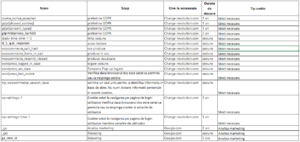
Click below to adjust your cookie preferences, in accordance to GDPR:
Change-revolution.com uses the services of the following third parties for the purpose of providing functionality, analysis and advertising. These third parties may set and use cookies and / or similar technologies on the websites and applications operated by Change-revolution.com, as well as on websites and applications other than those operated by Change-revolution.com. revolution.com.
For more details, please visit and check the data protection policies and the user preferences administration guidelines and the deactivation possibilities offered by the companies that manage these services accessible here:.
Google Analytics
Category: Analysis
Purpose: Web analytics
Policies: https://www.google.com/analytics/terms/gb.html, https://support.google.com/analytics/answer/6004245
Google AdWords
Category: Advertising
Purpose: Remarketing
Policies: https://policies.google.com/privacy, https://policies.google.com/technologies/ads
Google Maps API
Category: Functionality
Purpose: Points and estimated delivery near the user by reverse geocoding
Policies: https://policies.google.com/privacy
Google Doubleclick
Category: Advertising
Purpose: Display advertising